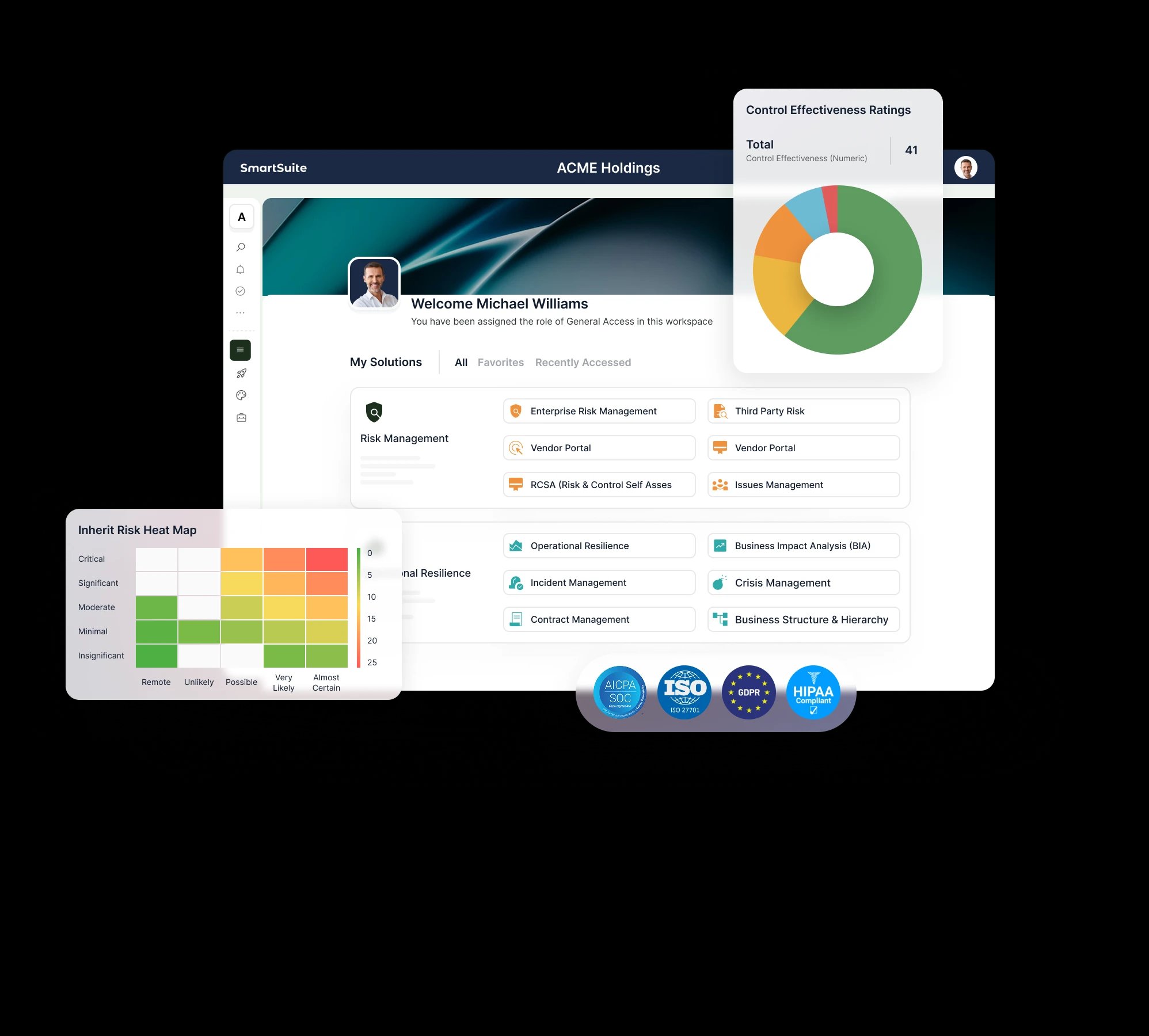
Enterprise platforms often sprawl across dozens of functions, and SmartSuite organizes its offering around two major operational areas instead. One side covers governance, risk, and compliance work, while the other handles IT service delivery. Understanding how GRC and IT service delivery modules relate to each other helps clarify why the platform is built as a connected system rather than a loose bundle of tools.
Understanding SmartSuite’s Two Primary Platform Areas
SmartSuite presents its enterprise suite as a connected GRC platform, but the site itself splits functionality into distinct groupings. One grouping is labeled GRC and Resilience, and its stated purpose is to standardize risk, compliance, audit, and resilience workflows in a single connected system, replacing processes that are often scattered across spreadsheets and point tools. The other is IT Service Delivery, which groups four modules under the stated goal of delivering IT services on one connected platform. A third area, Project and Portfolio Management, links project execution to broader organizational strategy, rounding out the overall structure.
This structure matters because risk and compliance teams rarely work in isolation from IT operations. SmartSuite‘s layout suggests that the two sides are meant to inform each other, rather than operate as separate silos. The remaining sections look at each area in turn before returning to how they connect.
GRC and Resilience: Risk, Compliance, Audit, and Governance Workflows
The GRC and Resilience area is where SmartSuite concentrates its governance tooling. This is also where the broader set of GRC and IT service delivery modules first becomes visible as a structured offering rather than a marketing phrase.
Within this area, SmartSuite groups modules by function instead of by department, covering everything from AI oversight to third-party vendor assessments. Each module description on the site focuses on a specific workflow, such as tracking controls, testing evidence, or managing remediation. That consistency across modules is part of what distinguishes this section from the IT-facing one described later.
Compliance Management and Third Party Risk in SmartSuite’s GRC Suite

Compliance Management is described as a way to centralize policies, obligations, controls, testing, and evidence in one place. That combination suggests the module is built for organizations that need to trace a policy through to the evidence proving it was followed. Third Party Risk Management, meanwhile, is built to assess and monitor vendor risk across the full lifecycle, from onboarding through ongoing review.
These two modules address a common pain point for compliance teams, which is keeping internal controls and external vendor exposure visible side by side. SmartSuite‘s module descriptions do not detail a specific scoring method, but they do confirm the functional scope of each area. As a result, teams working through audits or regulatory reviews can reference both modules without switching platforms.
Cyber and IT Risk, ESG Management, and Operational Resilience in SmartSuite

Cyber and IT Risk is positioned to track cyber risks, vulnerabilities, and security controls, connecting technical risk directly to the broader GRC suite. ESG Management covers tracking of ESG metrics, disclosures, and audit-ready evidence, which ties sustainability reporting into the same system used for other compliance obligations. Operational Resilience and Business Continuity links critical services, business impact assessments, continuity plans, and recovery steps.
Taken together, these modules show that the platform treats resilience as a cross-cutting concern rather than a standalone function. Cyber risk, environmental and social reporting, and continuity planning all feed into the same connected structure. That consistency is part of why the suite positions itself around connected GRC and IT service delivery modules instead of a single-purpose tool.
- AI Governance focuses on governing AI models through inventories, risk assessments, and approvals.
- Compliance Management centralizes policies, obligations, controls, testing, and evidence.
- Cyber and IT Risk tracks cyber risks, vulnerabilities, and security controls.
- Enterprise Risk Management unifies enterprise risks, controls, key risk indicators, and mitigation actions.
- ESG Management tracks ESG metrics, disclosures, and audit-ready evidence.
- Internal Audit Management plans, runs, and reports on audits and remediation.
- Operational Resilience and Business Continuity links critical services, business impact assessments, continuity plans, and recovery.
- Privacy Management manages data inventories, privacy assessments, and requests.
- SOX Management connects SOX controls, testing, deficiencies, and certifications.
- Third Party Risk Management assesses and monitors vendor risk across the full lifecycle.
IT Service Delivery: Service Desk, Asset Management, and Operations

Enterprise Service Desk, described under the acronym ESM, is meant to standardize service requests and approvals across teams, not just within IT. IT Service Management, or ITSM, manages IT requests, incidents, and changes in one system, which covers the day-to-day mechanics of running a help desk.
IT Asset Management, or ITAM, tracks IT asset inventory, ownership, lifecycle, and cost, giving organizations a record of what hardware and software exist and who is responsible for them. IT Operations Management, or ITOM, connects IT services, systems, incidents, and operations, rounding out the group with a more infrastructure-focused view. Together, these four modules form the operational backbone that complements the governance-focused GRC suite described earlier.
Connecting GRC Modules to IT Service Delivery for Enterprise-Wide Risk Control

The value of separating these two areas becomes clearer when considering how they might interact in practice. Cyber and IT Risk, part of the GRC suite, naturally overlaps with IT Asset Management and IT Operations Management on the service delivery side, since both sections involve tracking systems and incidents. SmartSuite’s site frames both groupings as part of the same connected platform, rather than as separate products sold independently.
This layout gives organizations a reason to consider GRC and IT service delivery modules together instead of evaluating them in isolation. A service desk ticket tied to a security incident, for example, touches both the ITSM module and the Cyber and IT Risk module. Because this suite positions these areas within one system, that kind of cross-functional visibility is at least structurally supported by the design.
Project and Portfolio Management sits outside the direct scope of GRC and IT service delivery modules, yet its presence next to them suggests coverage extending across planning, risk, and operations within one connected system. That breadth is a recurring theme across the module descriptions, and it reinforces why the two core areas were built to reference each other rather than stand apart.
Across governance and operations alike, SmartSuite‘s module list reads as an attempt to keep risk, compliance, and IT work visible in one place rather than scattered across disconnected tools.