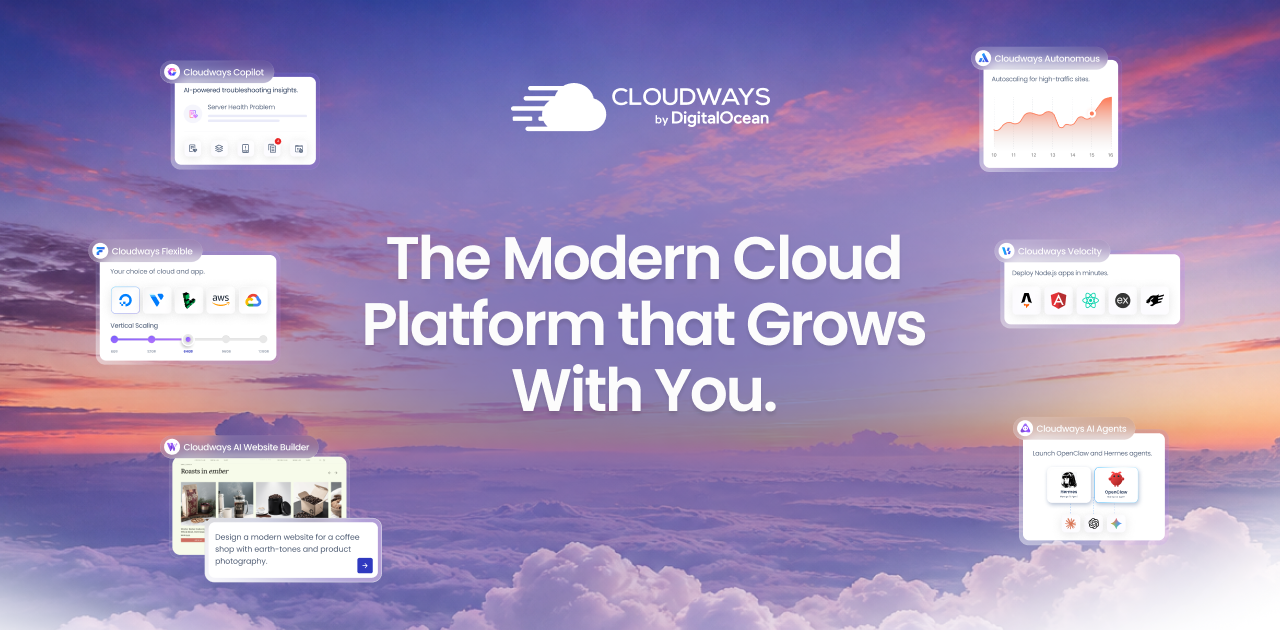
Modern web projects rarely fit into one box anymore, since WordPress stores, JavaScript applications, and AI agents often run side by side. Cloudways has built distinct managed cloud hosting solutions for each of these workloads instead of forcing them into a single generic server setup. The following sections look at how the platform separates these product lines and what each one actually provides.
Understanding Cloudways’ Core Managed Hosting Architecture
Cloudways describes itself as a managed cloud hosting platform built for the current era of web development, supporting AI agents, WordPress, and Node.js on one account. The platform states it manages over 600,000 web apps globally, which points to a fairly broad base of active projects. A flexible, high-performance option lets users choose their cloud provider, data center, server size, and PHP application, keeping control at every level.
That flexibility sits alongside more hands-off options for teams that prefer not to configure servers manually. Cloudways frames its approach as giving a choice between manual control and autonomous handling, depending on the workload. Because of this split, WordPress stores, Node.js apps, and AI agents are each treated as their own infrastructure path rather than a variation of the same server template, with management and scaling features tailored to the specific workload.
WordPress and WooCommerce Hosting with Autonomous Scaling
For WordPress and WooCommerce, Cloudways offers what it calls autonomous, hands-off hosting that scales automatically under traffic load. According to the brand, this removes the need for manual intervention when a store experiences a sudden spike in visitors. The autoscaling is specifically tied to WordPress and WooCommerce stores, rather than being a general claim across every product line.
This matters for store owners who cannot predict traffic patterns around sales events or seasonal demand. Because the scaling is described as autonomous, the platform positions it as requiring less day-to-day server management than a manually sized setup. That positioning is consistent with the broader theme of managed cloud hosting solutions reducing operational overhead for WordPress-specific workloads.
Velocity: Node.js Hosting for Modern JavaScript Frameworks
Velocity is Cloudways‘ managed Node.js hosting product, built for running modern JavaScript frameworks on both front end and back end. The brand describes it as offering predictable pricing, aiming to avoid what it calls bill shock and timeout walls. This distinguishes Velocity from the WordPress-focused side of the platform, since it targets a different category of developer entirely.
Running JavaScript frameworks often introduces unpredictable resource demand, especially with background processes and long-running requests. Velocity is positioned to let such applications run without hitting the kind of timeout restrictions that can disrupt back-end processes. As a result, developers working with front-end and back-end JavaScript stacks get a dedicated hosting path rather than one adapted from PHP-centric infrastructure.
Managed AI Agents and Infrastructure Deployment

Cloudways also offers managed hosting specifically for AI agents, described as infrastructure built to keep agents running without Docker setup, SSL configuration, or ongoing operations overhead. This is a notable departure from traditional web hosting categories, reflecting how deployment needs have shifted as AI-driven tools become part of standard application stacks. The stated goal is to let agents deploy on managed infrastructure without the manual setup steps that typically precede launch.
By removing the need to configure Docker containers or SSL certificates manually, this product line reduces some of the technical steps usually associated with deploying autonomous software agents. It sits alongside Velocity and the WordPress hosting line as a third, distinct category within the broader set of managed cloud hosting solutions the company provides. That separation lets each workload type draw on infrastructure suited to its own demands instead of a one-size-fits-all server setup.
Site Manager: Centralized WordPress Site Management
Site Manager is described as a single dashboard for managing every WordPress site under one account. Rather than logging into each site separately, users can view and manage multiple WordPress installations from one centralized interface. This is positioned specifically for WordPress, separate from the Node.js and AI agent hosting lines described above.
For anyone running several WordPress sites, whether personal projects or client work, a centralized dashboard changes how monitoring and maintenance get handled day to day. Cloudways presents Site Manager alongside its Cloudflare Enterprise integration, which is described as providing enterprise-grade speed and security. Together, these features point to a WordPress management layer that goes beyond basic server access.
Cloudways Copilot and Built-In AI-Powered Infrastructure Tools

Copilot is described as a tool built to fix server and application issues before they escalate into bigger problems. It is framed as part of a broader set of AI tools built into the hosting platform, intended to help infrastructure and workflows stay ahead of common faults rather than react to them after the fact. This places Copilot alongside Site Manager and the Cloudflare Enterprise integration as part of a wider push toward automated oversight across the account.
- WordPress and WooCommerce hosting includes autonomous scaling that responds to traffic spikes without manual resizing.
- Velocity gives Node.js applications a dedicated hosting path with predictable pricing instead of PHP-oriented infrastructure.
- Managed AI agent hosting removes manual Docker and SSL configuration steps from the deployment process.
- Site Manager consolidates every WordPress site into a single dashboard instead of separate logins.
- Copilot adds AI-driven monitoring aimed at catching server and application issues early.
Taken together, these distinct lines show how differently Cloudways treats each workload rather than applying one generic hosting template across the board. Anyone comparing managed cloud hosting solutions across WordPress, Node.js, and AI agent use cases can weigh which combination of autoscaling, dedicated runtime support, and built-in monitoring fits the project at hand.